
Setting up your new home
With the final deed signed and the home loan sorted, you’re about to face one of life’s most exciting challenges – moving to your new home. Whether you’re a new or an existing customer, we’ll make the process as smooth as possible.
Setting up your new home
With the final deed signed and the home loan sorted, you’re about to face one of life’s most exciting challenges – moving to your new home. Whether you’re a new or an existing customer, we’ll make the process as smooth as possible.
Setting up your new home
With the final deed signed and the home loan sorted, you’re about to face one of life’s most exciting challenges – moving to your new home. Whether you’re a new or an existing customer, we’ll make the process as smooth as possible.
Move into a connected home

Already using GO internet
Tell us when and where you’re moving so that you can can take us along with you to your new address.

New to our GO services
Get everything you need for your home with our customizable & pre-mixed options.
If you’re an existing customer looking to move your service, get in touch with us via Live Chat to get your service up and running in no time. Alternatively, fill in this form.

Moving home: How to get organised before the big day
From making sure that all things are packed and labelled appropriately to confirming all the details with the movers, we know settling into a new home can be a tricky affair.
Worried you might get caught out at the last minute? No need to. Take a look at this checklist of things to do in the weeks leading up to moving day.



We're here for you
Got a question? Confused about something?
Our support section features a wealth of information
you can go through whenever a problem crops up.
Alternatively, reach out to us on 
FAQs
If your home is still under construction or undergoing renovations, you must ask your electrician to pass what is known as a conduit pipe to rooms where you would like an internet point. This internet point could be a Wi-Fi access point or an ethernet access point, routed to where the modem is planned to be installed. Your electrician may also want to pass either a CAT6 ethernet cable, which is considered a superior network or a CAT5e cable. To date, both are supported.
You must also make sure that an entry point for the line feeding the modem from outside is prepared in that specific location. Lastly, remember to place your modem in a central location, so that you will have a wider Wi-Fi range across your house.
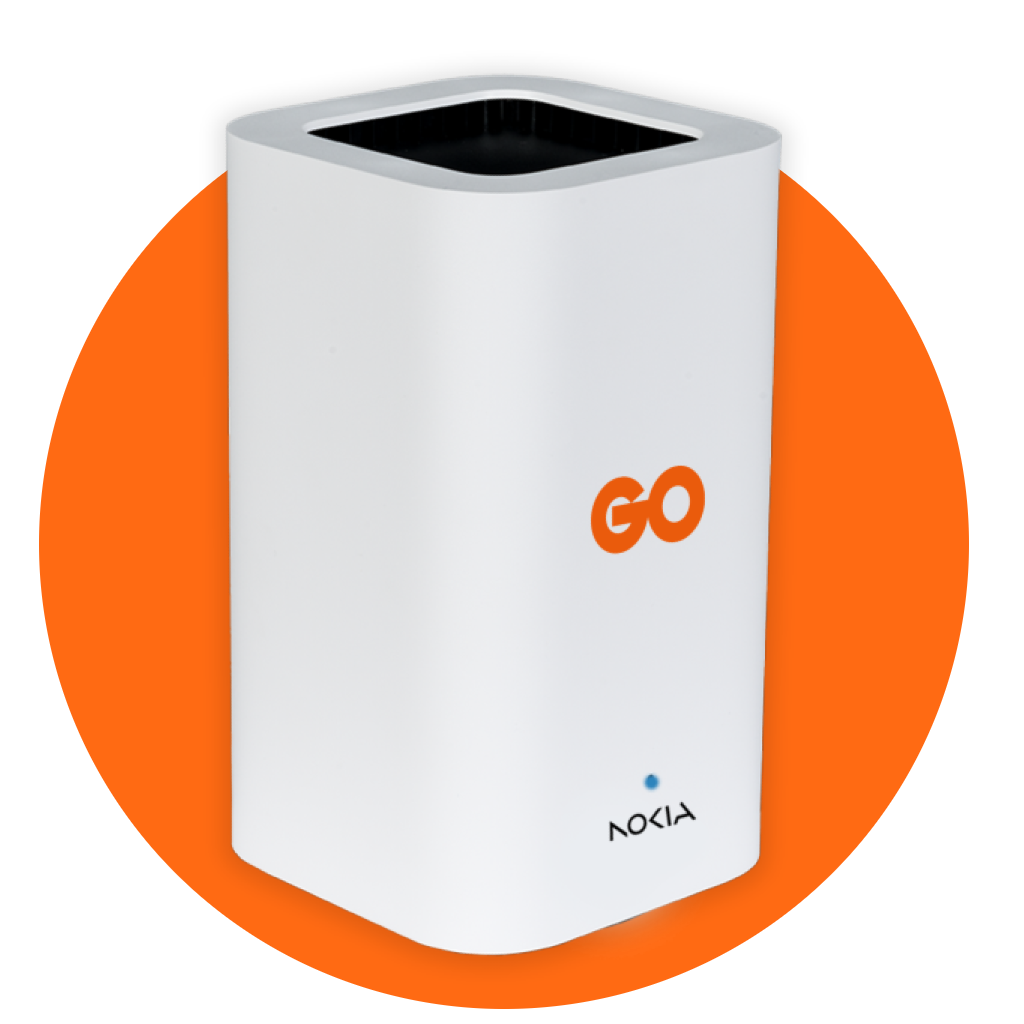
In contrast, if your home is already finished and you do not have the option to pass additional wiring, you can easily create a mesh Wi-Fi network using GO Smart Wi-Fi. To do so, all you need is an electrical socket for each Wi-Fi pod.
Looking to get connected at home? There are a couple of easy ways to set up internet in your space.
- Fibre Connection
Enjoy ultra-fast speeds (300Mbps, 500Mbps and 1000Mbps) with a fixed fibre line. - Plug’n’GO (4.5G)
Simply plug in this device wherever you have power and a stable mobile signal to stay online.
You can use both of these technologies:
- Via a wired network, with a choice of ethernet / Wi-Fi access points in main areas. Consider having an ethernet point in rooms where you are planning to have a TV and/or laptops and gaming set-ups.
- Via a Wi-Fi network from the modem’s in-built Wi-Fi connection or using a Wi-Fi mesh network such as Smart Wi-Fi.
Note: if your property is small and squarish in size (~60m2), you may not need extra ethernet or Wi-Fi access points. In that case, just position the modem near your TV or computer setup to make the most of its built-in Wi-Fi and ethernet ports.
We’d suggest you consider using CAT 6 cables – they’re really top-notch! These cables are built to handle frequencies of up to 250 MHz, supporting speeds as fast as 10Gbps, meaning they process more data in one go.
CAT 5e cables are also good to go. They can handle frequencies of up to 100 MHz and up to 1Gbps speeds.
The best location to install your modem in your home is in a central area that is close to where you typically use the internet the most.
Here are some tips to keep in mind:
- Your modem should be placed in a central location that is easy to access. By placing it there, the Wi-Fi signal will be spread evenly throughout your home.
- Avoid placing your modem near obstacles, such as walls, large furniture or metal objects, as these can interfere with the Wi-Fi signal and can reduce the strength of your connection.
- Place your modem on a shelf or table and not on the floor or in a basement. This can help to ensure that the Wi-Fi signal can travel freely without being obstructed by floors or walls.
- Your modem should be kept in a cool, dry location to prevent it from overheating. Avoid placing it in a hot or humid area, such as a closet or cabinet.
- Keep your modem away from other electronic devices that may cause interference, like microwaves, cordless phones and Bluetooth devices.